
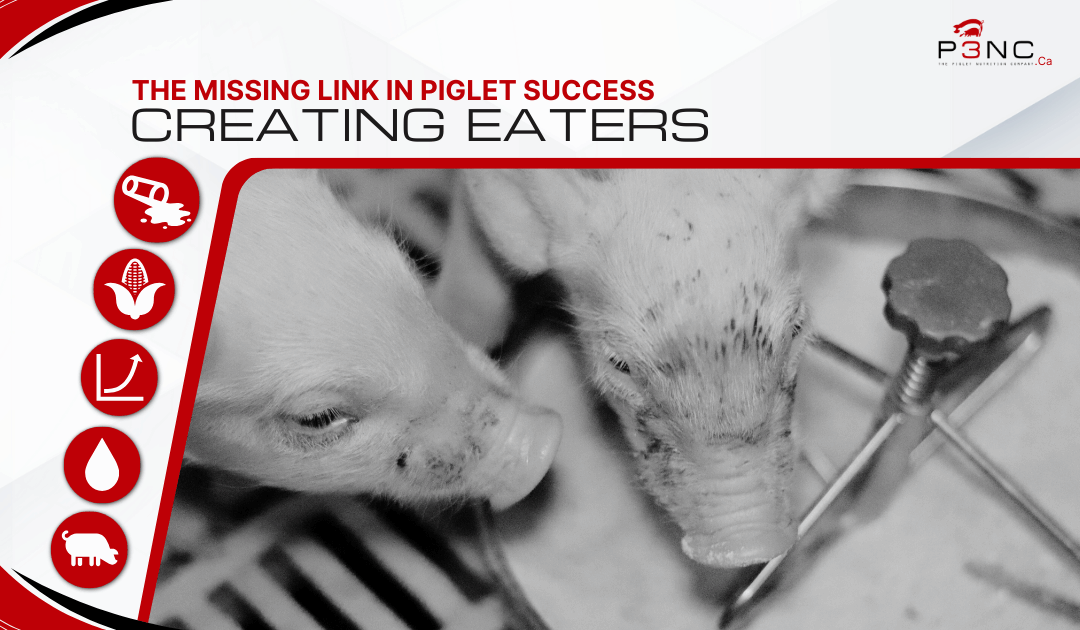
Creating Eaters – The Missing Link in Piglet Success
By Willem Steyn
Introduction: A Changing Weaning Landscape
We have reached an extraordinary milestone in modern pig production: larger litters, higher birthweights, and sows that produce more milk than ever before. While this is a tremendous achievement for genetic and nutritional science, it also presents us with a new dilemma. Piglets may thrive on milk in the first weeks of life, but life after the farrowing barn is a milk-free life. And for many producers, the biggest challenge remains the same: weaning. This reality means that pre-weaning supplemental feeding has shifted from optional to essential if all piglets are to leave the farrowing house ready for post-weaning life.
At P3NC Canada, our company is built around a simple yet transformative concept: Creating eaters! Rather than seeing feeding as something that starts after weaning, we believe it should begin the moment piglets are physiologically capable of consuming nutrients beyond milk. The idea is not just to improve early intake, it’s to condition the piglet to become a consistent and confident eater for life. Because if you can create an eater, you can raise a better pig.
Why “Creating Eaters” Matters
Weaning is a profound physiological, environmental and behavioural stressor that has the biggest impact on a pigs life in modern production systems. For decades, zinc oxide (ZnO) was the cornerstone for managing post-weaning diarrhoea, but regulatory withdrawal and environmental concerns have pushed producers toward alternative strategies. Many feed additives such as probiotics, prebiotics, and acidifiers, which can support gut health, but they do not solve the fundamental bottleneck: Piglets that are not conditioned to eat and digest solid feed before weaning.
The period immediately post-weaning is a high-risk stage marked by reduced feed intake, villus atrophy, enzyme suppression, and heightened disease susceptibility. Research by Pluske & Dong, (2007) shows that fighting among pen mates peaks within the first two hours after mixing; precisely when piglets should be consuming their first meal in the weaner pen. Kats et al. (1992) showed that pigs that lose or fail to gain weight in the first week after weaning required 10 extra days to reach market weight. Failing to eat opens the door for increased rates of mortality and financial losses long after the weaner house. Creating eaters is not a luxury, it is a necessity!
What Does It Mean to “Create Eaters”?
Creating eaters means designing feeding systems and strategies that teach piglets to eat before weaning, with the goal of having zero fasting piglets after weaning.
In reality, 10 hours after weaning, 40–55% of piglets have not eaten yet (Bruininx et al., 2001). Ironically, it is often the heaviest piglets, that relied entirely on milk, who struggle the most. That’s why creating eaters is not just about supporting the runts but preparing the entire litter for life after milk.
We believe piglets should consume no less than 500g, but ideally 900–1500 g of total feed each before weaning in a 28 day weaning system. If they achieve this, these piglets are physiologically and behaviorally equipped to transition smoothly, avoiding the post-weaning lag that sets many pigs back.
The 5 Key Pillars of Creating Eaters
- The Right Diet: Learn to Eat and Learn to Digest
Piglets are not miniature finishers. At birth, they lack the enzymes to efficiently digest complex plant proteins. Therefore, early diets must be built on highly digestible, soluble ingredients. But that’s not enough. To prepare them for life post-weaning, we must also train the gut to digest more complex ingredients.
At P3NC Canada, we break the pre-weaning phase into two feeding phases:
- “Learn to Eat” Phase: Using a high-solubility liquid diet like BPM2 (Baby Piglet Milk 2), we teach piglets how to drink from
- “Learn to Digest” Phase: We introduce Piggy Zero, a pre-starter dry feed formulated to gently challenge and develop gut
- The Right Feeding Program: From Liquid to Solid
Human babies transition from milk to solids over months; piglets have just 21–28 days. The transition must be gradual and deliberate.
We recommend:
- Day 4-10: Begin with BPM2, warm and in liquid form, 2–3x per day in small, fresh Enough that it is consumed within 20-30 min.
- Day 11-19 Mix BPM2 + Piggy Zero into a porridge, slowly introducing solids while maintaining Dry Piggy 0 should also now be provided in a separate feeder.
- Day 18+: Transition to dry Piggy 0, ensuring feeders are never empty, while maintaining multiple feedings per day to stimulate curiosity.
Consistency in texture, timing, and temperature is key. Following a phased feeding program with diets that follow on each other prevents abrupt changes in diet composition and nutrient levels, reducing digestive shocks and feed refusal. We want to build on the early momentum of learning to eat before weaning.
- Pre-Socialization: Reduce Social Stress Before It Happens
Weaning stress is not only about diet, social dynamics matter too. Fighting disrupts eating and eating delays reduce gut function and immunity.
That’s why we recommend removing partitions between 2–4 litters one week to 10 days before weaning, allowing piglets to pre-socialize. Strategic feeder placement across pens encourages shared eating and reduces post-weaning aggression. Studies confirm that early mixing leads to calmer pigs and improved feed intake. Care should be taken to reduce the risk of cross contamination with litters that might be scouring or have other disease loads.
- Water: The Forgotten Nutrient
Water is not optional. Dehydrated piglets won’t eat, and their gut function will suffer. In the final two weeks before weaning, provide extra water bowls, cleaned daily, to promote drinking and support dry matter intake.
- Feeder Type & Design: Eat Together, Thrive Together
Piglets are social eaters. They prefer to drink and eat in groups and stimulate curiosity among one another. Feeders must:
- Allow multiple piglets to access feed at
- Keep liquids fresh and within Never place in corners where piglets defecate.
- Transition from liquid to solid without changing feeder
Using the same creep feeder design before and after weaning builds familiarity and boosts early post-weaning intake. Feeders should allow porridge feeding for 3 to 6 days post-weaning alongside dry feed to bridge the transition and maximize the percentage of eaters. Piggy 0 mixed with warm water at a 1:2 ratio is the ideal porridge for this phase.
Results: Why Creating Eaters Changes Everything
The impact of creating eaters goes far beyond the farrowing crate. Efforts made in the first three weeks of life directly influence how piglets perform after weaning. When piglets are properly conditioned to eat before weaning, they experience higher post-weaning intake, which translates into stronger immunity, fewer health problems such as scours, reduced need for antibiotic usage and faster, more efficient growth. These are not theoretical benefits, they are observed in the field.
At P3NC Canada, we define success by results. Our target is for every piglet to achieve an average daily gain (ADG) of more than 250 grams in the first week after weaning, with the ultimate goal of reaching 300 grams per day. We aim for zero fasting piglets post-weaning, knowing that early eaters go on to achieve a lifetime growth advantage. Farms implementing our program consistently see reduced reliance on ZnO and antibiotics; because healthy, prepared piglets don’t need them.
Measurement and Success Indicators
Success isn’t determined at weaning, it’s measured when pigs are loaded onto the truck for slaughter. The true value of this program lies in long-term performance and profitability. Key indicators include lifetime average daily gain, the margin over feed cost, and total pork sold per batch. These metrics reflect the economic return of every decision made in the piglet stage.
In the nursery phase, we pay close attention to pre-weaning creep feed intake, with a target of 800 to 1500 grams per piglet. We monitor the average daily gain in the first week after weaning as a key indicator of program effectiveness. Just as importantly, we assess behavioural adaptation by tracking how many piglets begin eating within the first two hours after weaning; a simple but powerful measure of success in creating true eaters.
Conclusion
Creating eaters is about far more than simply putting feed in front of pigs. It is about developing confident, competent, and conditioned piglets that can eat, digest, grow, and thrive; without delay and without hesitation. At P3NC Canada, the “P3” stands for Prepared, Productive, and Profitable Piglets. This is not just a slogan, but the core of our mission. Piglets that learn to eat, learn to digest, and adapt before stress hits are better equipped for health, growth, and profitability throughout their lifetime. They transition faster, perform better, and ultimately deliver more pork.
This approach goes beyond providing feed to piglets by focusing instead on teaching piglets to eat and adapt to life without milk before the pressures of weaning arrive. Through planned and deliberate phased diet transitions, consistent raw materials, and strong management, producers can reduce reliance on ZnO and antibiotics, minimise weaning stress, and unlock better lifetime growth performance.
In today’s large-litter production systems, sending confident eaters out of the farrowing house is not a luxury, but a necessity for success. The shift we need is one that moves beyond nutrient specifications alone, toward feeding behaviour, gut training, and adaptation. Our goal should not be piglets that merely survive weaning, but piglets that launch from it and keep that momentum.
It is time to challenge the status quo and rethink standard practices and assumptions around us. Let’s start creating eaters early, raise stronger pigs, and do it the P3NC Canada way.